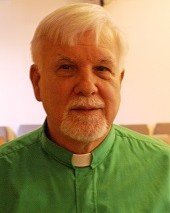
Earth Day Sunday 2017 at Redlands UCC

The latest report from scientists is a sobering report. The glaciers in Greenland are melting faster than first thought and now the western ice sheet in Antarctica with a sea level rise of 5-6 feet or more by 2100 and 20 feet by 2200. Already at high tide, the oceans are flooding the streets of Miami, and most of Florida is 1-3 feet above sea level. Coasts are threatened around the world, and a large majority of humanity live near the oceans.

The Trump administration has declared war of the Earth, denying the existence of climate change. Trump’s executive order this week attempts to roll back all the climate initiative of the Obama administration and its commitment to the Paris Climate Accord. The EPA have removed studies of carbon atmosphere studies, looking to remove discussion of the science that studies global warming.
Today, our scripture is the story of the Garden of Eden, but it is not just the story we are accustomed to hearing. It is the voice of the Earth. Just shifting the story from the human story-teller’s voice to the Earth mind remind us to listen to the voice of the Earth today.

God loves planting trees. The original garden. envisioned in the story of Eden, is a royal park full of trees or a grove of trees. God delights in planting trees. Trees are significant in the biblical and religious stories of humanity.

Let me focus on trees for a moment. In the Bhagavad Gita, Krishna observes:
The birth of trees is truly the most blessed in the world, for they contribute to the well-being of all other creatures. Just as no one needy returns disappointed from generous persons, so too one who approaches trees for shelter. They meet the needs of others with their leaves, flowers, fruits, shade, roots, bark, wood, fragrance, sap, ashes, and charcoal.

Trees are symbols in the spirituality of humanity—representing symbols of life, abundance, generosity, energy, food, strength, shelter. Trees are gardeners in their own right. They provide shelter for other species—plant, nonhuman animal life and insects. Leaves fall and decompose to create a rich humus-like soil. Trees circulate water from their roots into the trunk and branches. They protect biodiversity. Trees capture carbon dioxide and release oxygen that we and other non-human life require. Trees live in communities, and they are one of the most ancient life forms, for they stabilize the weather and are useful for recycling water. They are intelligent and have stable children. I have met redwood trees who are 800 years old and few trees 1600 years old in the Armstrong Forest in Russian River. They have stories to tell us and a wisdom to communicate to us if we chose to listen. In fact, the midrash on Eden came from a morning walk among the ancient redwood trees in the Armstrong Forest with my husband and companion dog. I listened to the trees and found a deep spirit within them, connecting to God’s Spirit and the risen Christ. And I realized that they were faithful gardeners as intended by God.

The female Nobel Peace Prize laureate and founder of the Green Belt Movement, Wangari Mathai writes, “When we plant trees, we plant the seeds of peace and hope.” Mathai has founded a movement whose goal is the reduction of poverty in Africa and environmental conservation. In order to protect biodiversity and forests, China legislated a law requiring its citizens to plant 4 four trees or pay for the planting of four trees. China has remained the top in human planting of trees in the world.

God creates the earthling—adamah from the humus of the Earth. The soil is able to hold God’s breath, and God is concerned for the earthling and creates animals for companions, but that remains unsatisfactory. So God e divides the earthling to create humans male and female. God compassionately cares for the welfare of each creature and the dirt creature now male and female. The Earth rejoices in all her children.

God commissioned the walking dirt creatures to care and serve the garden. And the walking earthlings followed God in gardening, caring and tending the community of the soil. They learned to work the abundance of life in the garden—preserving and caring the community of trees, plants and vegetative life, and other life. God expected the walking earthlings to follow in God’s vocation as gardeners and gave them one instruction not to eat of the fruit of the tree of good and evil.

Of course, we know that in the familiar fable, the couple in the garden ate from the fruit of the tree of good and evil at the prompting of the serpent. They became aware of their nakedness and now separated themselves from the animals in their nakedness.

And the Earth lamented, “Sadly, they lost all connectedness to myself and their siblings. They forgot their humus origins.” God placed them outside of Eden to learn how to re-connect to the Earth community once more. Humans, however, forgot a deep truth of the soil that all life shares a common ancestry from the humus or soil and are a part of the community of my body.

As I wept at the loss of my earth children, but God comforted me with hope. One day there will be a new earth creature (adamah) born again from the soil. He will be born from a cave tomb in a garden and become a great gardener, carrying on the mission of his parent who loves gardening. He will instruct humanity on gardening once more, and they will return to the community of the soil and once again connect to all life forms as an interdependent community of the soil. Hope was born once more in my dreams….

Humanity has lost its connectedness to the Earth and other life. Humans forgot their origins from the Earth and their soil community. Humanity is placed outside the garden to learn how to re-connect to the Earth. Instead we have continued to separate ourselves from the Earth and all other life.

Note that the Earth has not transgressed any intention of God. Nor have the trees, the plant life, or animal life. Both Celtic and Orthodox Christianities maintained that the Earth never fell. It still retains the holiness, its original innocence and blessing, beloved of God and carrying on their intended mission by God.

God comforts the Earth with the promise of new Adam, born in a cave with animals. He would be lifted upon a tree and die, but he would be buried in a cave in a garden. Let me point out that Golgotha was originally an olive grove of trees as well as Gethsemane and the grove of the resurrected Jesus. This new Adam, the risen Christ, will be a true gardener, following in God’s footsteps

Today humanity suffers from anthropocentrism, we are the center of the world. Everything is for our benefit. The Earth is our warehouse of resources to use whatever we choose. Animals exist for our purpose, and they are soulless, and we can hunt, abuse, and kill them for our use. They are inferior. We suffer from an arrogant apartheid the Earth and the community of life. Humanity practices an exclusivity not only with other humans but also with all life. We are exceptionally arrogant, and we are conditioned by our culture and religion to separation. Separation from the Earth is pervasive in our culture. That is why we can pollute, dump radioactivity and toxic chemicals into the environment. We can frack the Earth and explode mountain tops to get at coal. We factory farm, and not only raise and slaughter animals inhumanely, their waste releases methane into the atmosphere. It heats up the atmosphere 40 times more than carbon pollutants. If we reduce our eating of meat produced from factory farming, we could significantly reduce the warming of our climate.

And I will say strongly, “If we are separated from the Earth and the community of life, we are also separated from God.” We have as a church defined our ministry the radical inclusive love that Jesus practiced. There was a time when I as a gay man, along with other LGBT folks, were excluded, and we had to form a ghetto community to survive and practice our faith. Tearing down all walls that exclude and separate is not only the mission of Jesus but is our church mission; radical inclusivity and extravagant hospitality to everyone. And I would add to all life. I am proud that my own church made the Earth a member of our church eight years ago, and today they renew their covenant to the Earth and all life.

Christopher Uhl, a Professor of Biology and Ecology, has been interested, for decades, in environmental healing. You might be surprised. He understands that responding to the environmental crisis is not by repairing the environment. He argues that we first need to repair ourselves. This means to change our attitude and perceptions of ourselves and the Earth. That means we need to break down the conditioning of separating out our selves.We need to awaken, letting go our ego-centeredness and realize that we are interconnected with all life and the Earth. We are not above or separated from the Earth, but participants in the Earth community.

Chris Uhl talks about antidote to anthropocentrism that we are practicing here, for the solution is radical inclusivity. He writes,

Inclusivity is grounded relationship whereas exclusivity stems from separation. A consciousness rooted in inclusivity generates trust, one moored in exclusivity foments fear—especially, the fear of the Other. When our goal is exclusivity, we silence those with whom we disagree; but when inclusivity becomes our goal, we to create a world that works for all. (Uhl)

Inclusivity is the key, it tears down the barriers with any person or being or even the Earth. When I read John’s Gospel, there is the affirmation in the prologue: “The Word became flesh and lived among us.” A Danish theologian, Niels Gregersen writes,

…the incarnation of God in Christ can be understood as a radical or deep incarnation, that is, an incarnation into the very tissue of biological existence, and system of nature. Understood this way, the death of Christ became an icon of God’s redemptive co-suffering with all sentient life as well as with the victims of social competition. God bears the cost of evolution, the price involved in the hardship of natural selection.

This means that Christians hold a deep incarnational viewpoint that God’s incarnation did not start with Mary’s “yes” to the Angel Gabriel and her pregnancy. It started before the big bang and during the big bang when the molecules of Christ were formed. like our own, 15 billion years ago and later would form the embryo in Mary and the physical body of Jesus. This process of deep incarnational roots would spread through the resurrection of Christ into the Earth, all fleshy life, human and other, and the entire universe. The resurrection would tie us to risen Christ in a soil community in the Earth’s story. Jesus would become a new Adam.

Jesus described himself as the vine and us as the branches. The risen Christ is mistaken by Mary Magdalene as a gardener. What a prophetic insight Magdalene makes. The risen Christ restores us as members of the soil community, the community of the Earth.

Thomas Berry writes,

We come into being in and through the Earth. Simply put, we are Earthlings. The Earth is our origin, our nourishment, our educators, our healer, our fulfillment. At its core, even our spirituality is Earth derived. The human and the Earth are totally implicated, each in the other. If there is no spirituality in the Earth, then there is no spirituality in ourselves.

Brazilian liberation theologian Leonardo Boff claims, “the human being is the Earth who walks.” Or Zen Buddhist Teacher Thich Nhat Hanh , “We are the Earth and the Earth is in us. We have always been one with the Earth.”
Sallie McFague writes,

I am of the earth, a product of its ancient and awesome history, and I really and truly belong here. But I am only one among millions, no billions of other human beings, who have a place, a space, on the earth.

Pope Francis I reminds us, “We have forgotten that we ourselves are dust of the earth (cf. Gen 2:7). Claim your earthiness this Earth Day. Our siblings are suffering and dying. If we proceed as we are doing, a sixth extinction will occur in the near future. So today I want you to remember the theme of my new book, God is Green: If you fall in love with God’s Earth, you will fight for the survival of the Earth. The risen Christ is incarnated in all life and in the Earth. Let us practice our incarnational discipleship as gardeners and may the Trees this remind us that God intended us to be Gardeners.

The Queerest Week –Palm Sunday 2017

I have written queer theology for the last 27 years, and I now write about a period of 8 days, the queerest days that I can imagine. I am speaking from the moment that Jesus arrives in Jerusalem on a donkey to God’s resurrection of Jesus from the death.

Now let me dispel a notion: I am not writing about LGBTQI concerns, they are included but not the focus this morning. Queer theory and queer stories focus usually on LGBTQI concerns and inclusion in history, but I am speaking about God’s dream for life and humanity, and that dream is very queer. It is God’s unconditional grace and love for creation and all life.

Let me define queer for a moment. To “queer” is to interfere or disrupt. It is to transgress exclusive categories, notions, boundaries, and all boxes. I queer Christianity because it has remained exclusive, often violent and oppressive of someone or some life. Queering exclusiveness is to interfere and spoil exclusiveness and make it more inclusive.

My colleague and friend Rev. Dr. Patrick Cheng, understands queering as eliding dualism. Dualism is a destruction form of binary thinking used by dominant theologies, church leaders and politicians. It separates the world into male and female, culture and nature, the have and have-not, human and non-human, and so. For Patrick, God’s love is queer because it elides such thinking and behaviors. Dr. Justin Tanis comprehends queer as dawn or dusk, that liminal or ambiguous space between night and day. My deceased theologian and friend speaks of indecent and perverse. In Luke’s gospel, the Temple high priests bring a charge against Jesus before Pilate: “This man has perverted the nation.”

I have engaged with God’s Christ in Jesus of Nazareth. God, Christ, and the Holy Spirit have made me “queer” and more so over time. I describe myself as “a queer seeker of God and disciple of an even queerer God.” Jesus laid the foundations of ministry and message of the companionship of empowerment or kindom of God as a “topsy-turvy and upside-down kindom. He opens God’s table to everyone and upsets nearly every religious Jew of his time. Just listen to the parables of Jesus—the Good Samaritan, the prodigal son, the mustard seed, the baker woman who sneaks leaven into 50 pounds of flour, and so on. They provoke and disrupt religious exclusivism that reserves God’s grace and favor for the chosen “holy.”

My often quoted author, Diarmuid O’Murchu, calls the parables as “enlightened confusion.”

The story Jesus told them turned their world upside-down,
Bombarding every certainty they knew.
The boundaries were disrupted,
Their sacred creeds corrupted,
Every hope they had constructed,
Was questioned to the core!
By the story ended,
Stretching meaning so distended,
What they had known for long before.

O’Murchu speaks about Jesus’ parables. But what if we understand the gospel stories of Jesus as a parable about God? God is queering in the story of Jesus on a massive and unprecedented scale, not since the big bang. God has incarnated in a human being—such a queer and scandalous notion. God is queering and communicating a thoroughly queer and radically inclusive love. All are beloved—all humanity, all life, and all creation. No on is left behind or out.

Let me point out the queer highlights of this week:

For Jesus, God was a king unlike all kings and rulers. God’s rule was “queer,” meaning “not fitting in, strange, at odds with, out of place, disruptive, blasphemous, revolutionary, dangerous, outside the box, or my word “mischievous.” It is a topsy-turvy non-ruling but luring us through unconditional gift and love. God’s strategy is never coercive but always luring us through unconditional grace and love.

The Temple high priest and his colleagues brought Jesus before Pilate with the charges: “He perverted the nation.” Here “perverted” means inverting religious values, hierarchies, breaking all sorts of purity codes and religious laws for the sake of compassion. Jesus was always out of place; a peasant was meant to be quiet and subservient to the rulers of the Temple. Jesus spoke out compassion and was not afraid to break religious rules to extend God’s compassion.
Let’s examine today’s gospel a little more carefully. Unfortunately, the distribution of palms on Palm Sunday has become a spiritual blessing for us today. Many Christians tie up their palms into a bow and hang the palm crosses in their homes. And I am not opposed to anyone doing so if you determine to ask God to make you a bit queerer. But Palm Sunday has a deeper meaning than just the palms. Jesus rides on donkey into Jerusalem accompanied by a ragtag group of male and female disciples.

Jesus enters Jerusalem or to use biblical scholar Warren Carter’s phrase “making an Ass of Rome:” The conflict between Jesus and Pilate begins the day that Jesus enters in Jerusalem on the back of a donkey and praised as the “Son of David.”

Roman entrances into city were always triumphant. No red carpets, but soldiers trumpeting, followed by cadence war drums sounding the entrance of the conquering hero. In this case, it was Pilate who represented the triumphant Roman Empire and Emperor Tiberius. Days before Pilate rode on a war horse from the sea resort of Caesarea followed by marching his Roman legionnaires with standards, Pilate entered Jerusalem as conqueror and made it clear to the populace that the Rome was in charge of their city and their lives. They paraded and displayed extravagantly the power of Tiberius Caesar and Rome. It communicates Roman greatness and military power, reminding the crowds that they were conquered by the powerful Roman legions—the greatest power in the world blessed by the Gods. Augustine was the true Son of god Apollo, and the savior of the world.

But Jesus intends to literally make an ass of Pilate and Rome. He choreographs his own dramatic and symbolic entrance into Jerusalem. He queers some of the Roman ritual entry or rather mischievously reframes them as symbolic challenges. His entrance into Jerusalem reminds the Jews of their religious history in which God enters the holy city to serve, not dominate. He chooses an ass, not a war horse in which Pilate rode into the city. Matthew remembers the line from the prophet Zechariah: “Tell the daughter of Zion, your king is coming on an ass”(9:9). The rest of the verse states that your king comes triumphant and victorious, and humble riding an ass.

Jesus is recognized not as a king but more likely anti-king. He teaches humility, non-violence, compassion and love, forgiveness, and peace-making, empowerment through mutuality and service, not conquest and domination. God’s community is constituted by a new a kinship as children of God—not be wealth, prestige, gender, or ethnicity. It is constituted by God as Abba, our parent in love with all and equally. And God lives within us and in our midst.
Another example of this last week of Jesus’ life that reveals God’s queer activity among people as empowering mutual companionship is the Last Supper. Companionship is created when we share food together, and we eat with God in our midst. Companionship was based on exclusion but gathering together to eat with God and one another.

I want you to remember the video from Centering Prayer this morning, Eating Twinkies with God. https://www.youtube.com/watch?v=y9N8OXkN0Rk It expresses the incarnational vision of the Last Supper and Jesus’ ministry of eating together with God and finding God present.

There is no question that for Jesus the Last Supper had to be open and inclusive. I cannot accept the readings of the Last Supper as an exclusive meal. It goes against the very queer nature of who Jesus was and who God is. People from the highways and byways were to be invited into the meals. It was populated with diversity: outcasts, prostitutes, abominable people, tax collectors, those folks that terrify Pharisees and Christians alike. He did not moralize, berate them how to change their lives, or threaten them that could not share the table if they did not change their ways.

In Christianity’s Dangerous Memory, Diarmuid O’Murchu describes Jesus’ parables, healings, and ministry. The description is equally applicable to his meals and his to Last Supper:

They defy the criteria of normalcy and stretch creative imagination toward subversive, revolutionary engagement. They threaten major disruption for a familiar manageable world, and lure the hearer (participant) into a risky enterprise, but one that has promise and hope inscribed in every fiber of the dangerous endeavor.

There were no hierarchies at table, no one in charge and in power. There were only those who voluntarily served others, gladly washed the feet of their companions, who assisted folks at table to heal from the years of religious abuse and oppression. And God was mischievously present through each other. Jesus encouraged them to dream a future with hope, with God with shared resources and the abundance of food created by the companions of the bread and the cup.
Jesus’ Last Supper, like all his meals, undid social ordinary patterns and hierarchical behaviors, introducing people into a new egalitarianism, an equality before one another and God. No Roman official like Pilate would ever serve food to another person, especially with a male lesser of status or serve even his wife. No religious Jew would invite men and women together at table, suspected impurity and sinfulness.

And then there is the radical service of Jesus at table that evening– washing the feet of his male and female disciples. This was the service of only household slaves or women. No free male would do such a washing service because it demeaned his masculinity and patriarchal authority. Jesus turns the social hierarchies inside out, breaking down the gender boundaries and social hierarchies. There is only table fellowship of mutual service and equals, revering those who were the socially least, and inviting the disciples to imitate Jesus in his act of foot-washing.

Finally, Jesus dies a cruel death inflicted by the powers of imperial domination and religious exclusivism, always an unholy marriage of violence. It is an ultimate queering of human expectation, God’s vulnerability and suffering on the cross. God understood vulnerability in the incarnated Christ on the cross, and God identified with the suffering Christ and the least and vulnerable humanity and life in history. We have no comprehension of the depths of God’s suffering for all suffering life, but we do have a window into the depth of God when Jesus told his disciples: “Be compassionate as Abba God is compassionate.” Abba God suffered and died with Christ out of compassion, for God has suffered with all suffering life and human life. God the Creator becomes vulnerable and experience suffering the incarnated Christ on the cross and the Holy Spirit that groans and suffers with all created life. This is the queerest notion of God in history—God who becomes vulnerable and experiencing suffering. God is with us in so many unimaginable ways.

But the queer God surprised all of us. God said “no” to such violence and cruelty, God proclaimed a “yes to unconditional love” on Easter Sunday. Next Sunday I will speak how the queer God queers death for resurrected life!

Jesus the Refugee

Immigration and refugee settlement continues to be one of the most politically polarizing issues in America during the 2016 election cycle and the recent president’s executive order to ban immigrants and refugees from seven countries to enter the United States. I am not neutral on the President’s ban on immigrants and refugees. There are many issues that involved, from the targeting Muslims as a religion and the impact it has on families and business in the US. In addition, his ban places a death sentence on LGBT refugees from the seven countries that were targeted.

We have a banner on the church that reads, “Immigrants and Refugees Welcome,” with the image of Mary carrying the infant Jesus and Joseph leading the donkey to Egypt. Ironically, Joseph was displaced to Nazareth from Bethlehem, and he comes to Bethlehem for the census and cannot find shelter as a native son. Now Rev. Al Sharpton tweeted, “Before you head to church today, remember to thank God for his son, Jesus a refugee who fled to Egypt.”
But the response from fundamentalist Christians to this tweet: “They went to pay Taxes in Egypt. They went home. YOU need to pay your taxes and learn Bible!” Fox slammed Sharpton similarly for using Jesus to tackle the Trump ban.
Now to those who claim that Mary and Joseph went to Egypt to pay their taxes, there is no scriptural evidence from the Gospel of Matthew. After the visit from the Magi, an angel appeared in a dream and warned Joseph: “Get up, take the child and his mother, and flee to Egypt and remain there until I tell you, for Herod is about to search for the child to destroy him.” (Mt. 2:13) Fleeing to Egypt to avoid death is not going to Egypt to pay taxes. This is really “fake” truth or invention of alternative truth to support the ban by racist Christians.

But after the birth of Jesus, Mary with child in her arms and Joseph flee from the persecution of Herod the Great, who dispatched his soldiers to Bethlehem, to kill all male infants from age 2 and under. At the heart of the gospel story, when Mary and Joseph took their infant son Jesus and fled to Egypt, they became refugees. They journeyed as refugees to Egypt.

Joseph took his family and fled to Egypt. There they lived lives as aliens, outsiders. They didn’t speak Demotic, the language of 1st century Egypt, and they were relegated to the most menial of labor. I am awed by the depth of their pain and suffering of refugees. There is often loneliness and strangeness of living in a foreign country that places a strain on immigrants and refugees. Jesus’ parents experienced what it meant to be refugees from violence and seek re-settlement. It is part of the gospel to proclaim Jesus the refugee. Jesus was an alien and refugee, and later an outsider.

Our biblical heritage is full of stories of the chosen people as immigrants and refugees. Abraham migrated from the city of Ur to Canaan, seeking a better life and opportunities. Jacob and his sons and their families migrated to Egypt due to famine, and a couple centuries later, the Hebrews under the leadership of Moses fled slavery and oppress in the Exodus. Ruth migrates with Naomi from Moab to Canaan, and Ruth a foreigner becomes the great grandmother of King David. Many Hebrew families were forced into captivity and go into exile by the Babylonian conquest. The exile was a forced migration and resettlement. The Hebrew and Christian scriptures are full of migration and refugees.

I would argue creatively that God’s incarnation in Jesus is also migration from God to humanity—God with us. As I mentioned in the birth stories of Jesus, Mary and Joseph fled Bethlehem to Egypt to save the life of Jesus as an infant. They were refugees in Egypt.

Now listen to this story of Maria: Maria, a refugee from a different part of the world, perhaps Syria, was 20 years old when she also had to flee a step ahead of soldiers.

My husband woke me in the middle of the night. He told me we had to leave right away. He had a warning that soldiers were coming. We could take only what we could carry. I wrapped the baby to keep him warm. We walked for days. Later, we heard what the soldiers did: they killed all the boy babies in our village. Where we live now, the food and the language are strange. My baby is growing up without knowing his home country. Built isn’t safe to go back, not yet.

This story sounds very close to the story in the gospel of Matthew and the flight to Egypt of Joseph, Mary, and Jesus. I am horrified that the holy family as well as Maria, her husband, and child could be turned away from our country and not granted political asylum. The holy family would now be turned away by homeland security and to go back to Bethlehem.

In our country, we welcome immigrants with green cards, except from the banned seven countries where the Trump administration designated. There are, at least, 12 million undocumented migrants in the United States, and there are nearly two million dreamers, those who were brought to the US as children by their families. They made no decision on their own to cross into the US legally, and the Obama administration asked those dreamers to register. They are terrified at the new administration targeting themselves for deportation. Or those who have crossed the southern border from Central America, fleeing for their lives. We welcomed several refugees from San Salvador, who fled for their lives because they were gay. They were threatened and beaten up for being gay.
Numerous Christian churches and Jewish synagogues have adopted Syrian and other refugee families in their relocation to the US. Refugee families migrate from their home countries from the circumstances of war, oppression, and poverty. All of us, unless descendants of Native Americans, are immigrants. How many Europeans and other nationalities migrated to the US because they were persecuted? Many Europeans came to North America because of religious persecution and oppression while others came for economic opportunities. But they not learn from their experience and appreciate the indigenous people in North America. We displaced many Native Americans from their lands and forced them to live on ghettoized reservations. And now we displace them with oil pipelines. And in the future, are we prepared for the hundreds of million and even billions of human beings who will be climate refugees.

I am the a 3rd and 4th generation descendant of immigrants to the US from both sides of my parents. I suspect that many of us here this morning could claim the same. My Greek grandmother and her sister came from the Greek island of Samos through Ellis Island. They were both unable to read or speak English then. But on Ellis Island were written the bold words of Emma Lazarus:

Give me your tired, your poor, your huddled masses yearning to breathe free, the wretched refuse of your teeming shore. Send these, the homeless, tempest-tossed to me, I lift my lamp beside the golden door! (Emma Lazarus)

The American ideal, enshrined in these words at Ellis Island and the Statue of Liberty, are embodied in our scriptural tradition of welcoming the migrant and the refugee. Do we dare look upon those strangers, refugees and immigrants welcome them with the value and love that God has for them? Or do we fall into the hysteria and exclusivist vision of rejection espoused white nationalist and racist Christian churches intertwined in a holy union of nationalism with hatred and bigotry? For remember Christ’s words, “Truly I say to you, just as you did not do to one of the least of these, so you did not do it to me.” Do we dare to reject Christ in the face of the immigrant and the refugee? I will never reject the Christ in the refugee and the immigrant. My roots and your roots go back to our ancestral immigrants and refugees.

As you listened to the various scripture verses read antiphonally by Layne and myself, we realize that our religious ancestors in the Hebrew and Christian scriptures were often migrants and refugees.

Jesus teaches us how we individually and collectively treat the least of our sisters and brothers–who are now refugees and immigrants– is the way we welcome and treat him. In the world’s refugees, we encounter the refugee Jesus.
In an article on refugees in the Dictionary of Christian Ethics, Roy Branson observes that:

While Christianity affirms the importance of the individual stranger, it also values community. The sanctuary movement [that is, the historic practice of offering sanctuary to those fleeing danger] not only draws attention to the exile but also to the cities of refuge. As in designated Old Testament towns, and in British and European cathedrals into the 16th century, security from retaliation and injustice must be provided … The theme of exiles and pilgrims as the chosen of God, who must in turn welcome the stranger, is so strong a theme in biblical faith that it creates a presumption in favor of admitting the immigrant, granting asylum to the refugee, and treating the alien as an equal.

The church consists of “foreigners and exiles” (1 Peter 2:11). It was a church of independent women, slaves, various ethnicities, and different classes that came to together as Christians. They were outsiders and from many cities. Many LGBT folks have been treated as foreigners and exiles. The same Christians who do not welcome us, usually do not welcome refugees and exiles; they are outsiders to be feared and shunned. These Christians express an amnesia of their biblical heritage. But they ignore God’s preferential care for the outsider, the foreigner, immigrant, and refugee. One UCC clergy, Rev. Matt Fitzgerald, involved in a Syrian family re-settlement program at St. Paul’s UCC in Chicago, observed:

The people of Saint Paul’s know what it is to be ‘a stranger in a strange land…Therefore, our church has a strong, clear, continually rewarding spirit of hospitality. Welcoming a Syrian family felt like an extension of who we are, rather than a new direction or a risk. Our simple act of Christian hospitality looks bold because of President Trump’s anti-Christian executive order. In a time like this, all the church has to do is be the church for our light to shine brightly.(Supporting the Stranger, KYP)

Like Jesus, we know what it’s like to be outsiders. Many of us have been targeted and excluded as outsiders, despised for sexual orientation or for gender variance. In the world’s refugees, we meet Jesus Christ the refugee. We must reject the racism of the Trump ban, the fears building the wall, and any deportation force that takes away our neighbors. It is not acceptable to surrender to policies based on fear and racism,

Pregnancy an Birth: Creation and Incarnation (Christmas Eve: Luke 2:1-20)

Luke’s gospel chapter 1 is about pregnancies: 1) the pregnancy of Elizabeth in her old age, who carries in her womb the future John the Baptist. 2) the pregnancy of young 13 old Miriam, who carries Jesus in her womb.
I would like to share some reflections this evening: My first is that pregnancy results in birth and life. All women reflect a deep mystery of Creation in pregnancy. I am actually speaking about gestation in the womb and do recognize that it usually takes a male and female to bring about pregnancy. Now I am speaking as a male, and I think a mother who could describe pregnancy better than myself from first-hand experience.

For me, creation is a stunningly amazing act of God’s generativity that is directed towards life. Years ago, I read a German theologian who wrote about creation. He imagines before the Big Bang, all space in the universe and beyond was God’s space; it was filled by God alone. Just before the Big Bang, God withdrew from God’s space to make room for creation. God creates by letting be, by making room, and by withdrawing God’s self to allow the infinite space of matter expanding into galaxies and beyond. This has been traditionally interpreted as God creating the universe from nothing. But this is more richly understood as maternal gestation in preparation of the birth of the universe. Like pregnancy, God’s womb is an act of hospitality, a welcoming into being. Several feminist theologians have strongly suggested this is analogous to pregnancy:

And it is clearly the parent as mother that is the stronger candidate for an understanding of creation as bodied forth from divine being, for it is imagery of gestation, giving birth, and lactation that creates an imaginative picture of creation as profoundly dependent on and cared for by divine life. There simply no other imagery available to us that has power for expressing the interdependence and interrelatedness of all life with is ground. All of us, female and male, have the womb as our first home, all of us born from the bodies of our mothers, all of us are fed by our mothers. (McFague)

All life-giving activities result in birthing. Women during their gestation period reflect God’s creative process of making room in God’s self for the birth of creation. This metaphor portrays how we live in the womb of God’s universe that has given life to us and an infinite multitude of life. As we born into the universe, perhaps the Holy Spirit might be understood as the umbilical cord that continues to link us to our divine parent. This means creation is till in the womb becoming what God intended.

Let me shift to Mary’s pregnancy. Mary becomes pregnant without Joseph as father. Being pregnant without a finalized marriage left Mary and Joseph in a socially awkward and religious predicament. The gospel of Matthew pictures the dilemma that imposes upon Joseph a difficult decision whether to divorce the pregnant Mary, denounce her, or finalize the marriage until God came to him in a dream and revealed that this was God’s birthing a child. English author Nick Page writes, “The story of Jesus’ birth is not one of exclusion, but inclusion…Joseph’s relatives made a place for Jesus in their heart of their household. They did not shun Mary, even though her status would have been suspect and even shameful (carrying an illegitimate child) they brought her inside. They made room for Jesus in the heart of a peasant’s home.” Joseph and his family made room for pregnant and unwed Mary in their family. Making room or hospitality is really inclusion; it reflects the reality of God creating the universe and us. God is about radical inclusive love, making space within God’s self for creation and birthing life. This making room is manifested in Joseph’s inclusion of Mary and Jesus into his own family. Hospitality is a sort welcoming into the womb of the house and family, for it is what church is.

Mary travels with Joseph to Bethlehem. The physical ordeal of riding on a donkey during pregnancy for several days is hard for me as a male to physically comprehend, and I suspect that the ride to Bethlehem induces labor pains and the birth of Jesus. The couple cannot find any room in Bethlehem and search out shelter in a canvasserie (cave-like shelter for travelers) that house domestic animals outside of Bethlehem.

“Is there room in our inn (or church) for Jesus?” In this time of fear, undocumented folks in the US fear that there is no room for themselves in our country. They remain publicly unwelcomed. Many folks of good faith are asking themselves: “How can we — and our world, our state, our church — make room for the politically unwelcomed who are undocumented?” A 83 year old Jewish atheist whom I met at a wedding that I officiated here, asked me, “how can I make my house a sanctuary.” Another non-Christian friend has told me that he has a secret underground room with electricity and water and that he plans to hide undocumented folks threatened with deportation. These and others realize that hospitality, making room for those at risk and emotionally traumatized by the political election, has become too real in reflecting the story of the birth of Jesus and the later need to flee as refugees from Bethlehem as Herod seeks out to kill Jesus and his family.

Now Mary gives birth to Jesus and lays him in a manger, a feeding trough. The feeding trough is the least of all social places to lay a newly born infant. But the Christ child shares space with domesticated animals. We often take that as poetic convention that adds a warm familiarity or sentimentality to our Nativity crèches. The manger reminds that non-human animals are considered by humans as lower than the least human and just barely above slavery, a prominent institution of burden and oppression that kept the Roman Empire working. But I take the birth of God’s incarnate child in the canvasserie with non-human life and laid in a manger a evelation: it points out that we human animals share space with non-human animals from God’s perspective. Listing the creatures together, which occurs frequently in Hebrew scriptures, suggests the importance and the belovedness that God has for non-human animals. “God so loved the world that God sent God’s only begotten child….” (Jn. 3:16) The manger reminds that God is not born just for humanity, but for all non-human life and the Earth. God became flesh dependent on the eco-systems for nourishment and protection. Christ’s birth calls us to recommit to protect the Earth and all life: the trees and life in the rainforest, the whales, the oceans and the lands. These share earthliness as the new Adam, the divine earth-creature is born.

The marginal location of the birth of Jesus makes it accessible to the marginalized shepherds outside of the town of Bethlehem. Angels appear to the shepherds, announcing “Today in the city of David, is born a savior, who is Christ the Lord.” The shepherds are told to search for a sign—a baby wrapped in swaddling clothes and lying in a manger. This, of course, is an unusual sign for a Savior and Lord, born in a cave with non-human animals. And in Luke, shepherds, outsiders and despised Jews, came to venerate him in a feeding trough as Savior and God’s Child. They did not leave their flocks behind but brought them along. The shepherds too found inspiration and hope for then and the future, for an innocent child in a feeding trough illuminated by a star and the arrival of expectant shepherds who experience wonder. This child born in a cave is good news for marginalized and despised shepherds, but this good news for all who are poor and oppressed. And the shepherds returned praising God for what they had experienced.

One of the strong and clear messages from the Nativity of Jesus is that we Christians cannot truly love the infant Jesus without loving nature, other life, and the marginalized. But there are some important words that we often overlook: “Mary treasured these words and pondered them in her heart.” Treasuring the words of the shepherds and their coming to see the birth of her child and pondering this in her heart are important part of the Christmas story. We are called to treasure this story and ponder its meaning for ourselves.

Treasuring and pondering are the essential skills for meditatively comprehending God’s incarnation. Mary gives an example of how to become pregnant with the living Christ and birth Christ into the world. Christ becomes a part of our fleshly and metaphoric wombs, and that means men as well as women. By saying “yes” to God’s offer of grace and unconditional love to the Angel Gabriel, Mary becomes pregnant with the divine Word, the Christ. Through faith, Mary comes to ponder and keeping in heart the finding Jesus in the Temple, his ministry and death on the cross, and his resurrection. By paying attention to the gospel story tonight and other gospel stories, we carry mindfully the incarnation of God’s compassion in the world within ourselves.

We are called in this story to pay attention to God’s enfleshment as a newborn baby. The birth of any baby elicits an emotional response for care. This becomes ironic for us. We are called to care for the well-being and nourishment in the infant in the manger. Our invitation to use our instinctual desire to care for the well-being of the God become child. Heart and mind become mindfully focused on this child before us tonight, everything else in our lives becomes secondary to paying attention and caring for the Christ child. This same attention of heart and mind to the infant Christ becomes an invitation to pay as close attention to the poor and suffering in the world, human and non-human life and the Earth herself.

One author writes,

On Christmas Day, we are invited to the humble place where God is new and needing. We are to practice thinking and caring for what is not me, or even us, to rethink how we are in the world, how our doing affects the welfare of a world inhabited by God who at this moment needs for us to pay attention (like Mary) and out of that that attention to create the conditions of health and security at the manager (which is everything in the world). (Kristin Swenson)

My colleague and clergy friend, Tom Bohache, writes something complementary:
…incarnation is an acceptance that we bear Christ within us—the part of God that is instilled in us to bring forth from ourselves the offspring of Christ-ness: self-empowerment, creativity, awareness of creation, joy, love, peace and justice-making to name a few.

Tom Bohache acknowledges when we follow Mary’s example of treasuring the moment and keeping it ever mindful, the mystery of the Nativity lives on in us—we become pregnant with Christ and we too give birth to Christ.

…the Nativity is the realization that Christ will be born, no matter what the circumstances. No matter how hard it is, no matter how perilous the journey, no matter that folks might not receive us, once we agreed to give birth to Christ; most will go about their business and oppressing others. Some, like King Herod, …will seek to destroy what we have birthed; they will seek to take our Christ presence away from us.

God’s blending of the human and the divine in the birth of Christ is God’s greatest work, Christ is the blueprint of what is happening to us tonight. The reality is that during Advent the gestation of Christ within ourselves leads to Christ’s birth in us. The scandal of God’s birth in human flesh is that it is not once and for all; it is promiscuous. It happens hundreds of millions, if not billions of time, that God is born in us. We become Christ living in the world, manifesting God’s forgiveness, love, peace, compassion. We are infused with Christ, thus like Christ we become God’s eyes; God’s arms and legs, we become God’s compassionate incarnation. That is truly a radical mystery because God is willing to be ultimately inclusive by emptying God’s self in a network of humanity, all life, and creation alive. Creation and Christ’s incarnation continues to happen, and there is no stopping this flow of radical inclusive love. Love conquers not only death but all obstacles to life-giving and birthing the abundant, unconquerable compassion of God in creation, in the reality that we know. Merry Christmas, for you have birthed tonight as the Christ child. And we sing with the angels: “Glory to God in the highest heaven and on the lowest margins of the Earth…”

The Tree of Jesse: Isaiah 11:1-10

Come Promised One!
Do not smile and say
you are already with us.
Millions do not know you
and to us who do,
what is the difference?
What is the point
of your presence
if our lives do not alter?
Change our lives, shatter
our complacency.
Make your word
flesh of our flesh,
blood of our blood
and our life’s purpose.
Take away the quietness
of a clear conscience.
Press us uncomfortably.
For only thus
that other peace is made,
your peace.
-Dom Helder Camara

This second Sunday of Advent reminds us that we are waiting with anticipation for the fulfillment of this vision of Jesus leading us to the peaceful reign of God, where God lives among us in peaceful harmony. Martin Luther King Jr. claimed, “The Arc of the Moral Universe Is Long, But It Bends Toward Justice.” For those dismayed with the election results and their consequences, we need to hold in faith the statement Martin Luther King Jr. The prophet Isaiah speaks of the “stump of Jesse.” The stump of Jesse offers us hope, peace, and the regeneration of spiritual vision that God is presence and God is Emmanuel.

I remember in Catholic school we had a Jesse tree for Advent. Jesse trees are an old Advent custom, dating back to the European Middle Ages. They were used to tell the biblical stories from Creation to Christmas. There were twenty-five stories from the Bible told and ending with Luke’s story of Jesus born in a cave and laid in a manger.In a time when literacy was low, the Jesse tree was an educational opportunity to relive the biblical events leading to the birth of Christ. But the Jesse tree was used to speak about the genealogy of Jesus from Jesse the father of the great King David in the Hebrew scriptures to Jesus his descendant.

Now picture what a stump looks like. It is a tree chopped down to a stump, and most view this as an eyesore. I had one in my yard in St. Louis. It was 30” diameter, and it took a year to chop this hard wood and getting to the rot. There were no ragged branches growing out of the stump. It was about 2 feet off the ground and quite dead. If there were branches, I would have let them grow because it was a wonderful old maple tree. New life from a stump is a wonderful sign of rejuvenated life. It gives us hope.

Isaiah is a story teller, a prophet– whose purpose to speak forth God’s truth to the present generation. Christians from the first generation on, have understood this truth of the Jesse stump from the prophet Isaiah as a fore- telling of the coming of Jesus and how God’s reign will continue to be made visible and tangible among us. The prophet Isaiah offers a vision of God’s presence through chosen people to “a new David,” who will lead us and all life and all creation to a place where we co-live in peace with ourselves, other life, and the Earth as well.
Stumps on the ground are often able to regenerate into new trees, sprouting new growth and branches. A stump sprouts can grow very quickly and sometimes become viable trees themselves due to the existing life and vitality in its roots. Life regenerates from the stump. Likewise, Isaiah provides a vision of the coming messiah:

A shoot shall come out from the stump of Jesse, and a branch shall grow out of his roots.

The time of the prophet Isaiah was a perilous time. Israel was divided into kingdom, Northern Israel and Judea. And both were threatened by the superpowers at time—Egypt and Assyria. Assyria would conquer Northern Israel and transports it aristocracy into exile, and Assyria would lay siege to Jerusalem and fail. In other words, Israel’s enemies had tried every way to seal off the stump of Jesse that was the root of the throne of David and had taken the Israelite elite into exile. Jesus’ ancestors suffered all this and more. And yet, somehow, there was still life still stirring in this old stump. Jesse was the stump, the father of epic colorful King David of the Hebrew scriptures, but Jesse was the son of a colorful, non-traditional family. His grandmother was Ruth, a woman from the country of Moab and not a Hebrew, and she was bonded to Naomi. Jesse’s grandmothers were Ruth and Naomi. Ruth lost her husband, the son of Naomi, and followed Naomi from Moab to Israel with these words:

Do not press me to leave you or turn back from following you. Where you go, I will go; where you lodge, I will lodge, your people shall be my people, and your God my God. Where you die, I will die, there I will be buried. May the Lord do thus and so to me if even death parts me from you.

Women who loved women have often used this scripture for their holy unions. But let me tell the story of Ruth a bit further. Ruth accompanies Naomi back to Israel, and Naomi instructs Ruth to pick up the left over grain in the fields of her relative Boaz. Boaz notices her. And Naomi instructs her to go to Boaz at night and uncover his feet in bed, and she does so and becomes pregnant.
At the end of the Book of Ruth, the women come to Naomi, saying, “A son has been born to Naomi.” They named him Obed, who became the father of Jesse who was the father of David, a shepherd boy that became a leader. Some LGBT Jews and Christians understand this as an alternative, bisexual family. These are the marginal ancestors of Jesus.

When you think about it, it is an odd image to use to describe Jesus. He’s the new King of Israel, and he is described as a fragile branch growing out of an unsightly old stump. Not a very triumphant or powerful image. But that’s what Advent is all about. It is about coming to terms with the profound knowledge that God choses to become human and vulnerable, a defenseless human baby, dependent upon parents to survive. His parents would be unable to find shelter except in a cave with domesticated animals, and he was placed after his birth in a wooden manger.

Neither a baby nor a small branch growing out of stump is going to last long in a hostile world. The little shoot branching out of the stump could be cut down at any moment. In fact, the Gospel of Matthew tells how King Herod tries to cut down that branch and brutally kills all innocent male infants in Bethlehem from age two and under. The political world of power, greed, and intolerance cannot accept the possibility of a peacemaker. Religious and political empires, led by Herod or represented by Caiaphas and Pilate, would later join forces to crucify this child of peace—who threatened the very fabric of oppression and violent power.

God risks vulnerability in the branch of the tree of Jesse, a little child. What is true about branches growing on trees is that they branch out right on the edge of the trees. New growth is produced right at the very outward edges of the tree, and it builds outward, fragile branches and leaves. The human birth of the incarnate one was born out of a tree which had been chopped down to a stump, and God chose to bring new shoots out of the stump.

It is ironically that Jesus was adopted by Joseph a carpenter and wood artisan, and that Jesus would also become a carpenter in his years. The Jesse tree buds into new life as Savior and Messiah, but the lineage and theme of trees continue in the life of Jesus.

That new shoot of the Jesse tree, Jesus, is chopped down again and hung on the cross. In Greek Orthodox icons of the crucifixion of Jesus, there is a scull at the foot of the cross. Greek Orthodox uses the scull at the foot of the cross to mark the location on the Golgotha where Adam and Eve ate from the Tree of Good and Evil in the Garden of Eden. In the Garden of Gethsemane, an olive grove, Jesus was betrayed to the Temple guards, and on Golgotha, once a garden grove of trees, Jesus was crucified on the dead wood of the cross. Even with God’s presence in Christ things never went without obstacles and challenges. But God brang resurrected life out of the stump of the cross. Jesus becomes the new Tree of Life on Easter morning.

Symbolically, the lineage of trees from the Jesse tree expands in communities of trees down the age to the risen Jesus, the Tree of Life. I now cannot look at a tree or a community or forest of trees without seeing the Jesus the Tree of Life is rooted in all trees. The incarnate one is rooted into the Earth and the community of Earth life. The incarnate God has roots in the Earth.

Our God is totally green vitality, and great medieval abbess and saint, Hildegaard of Bingen, called this vitality of life that is God—viriditas, the greening vitality. Our God resurrects and sprouts new green life when the forces of violence and power try to deforest the world of hope and peace or when they chop down the giving tree. Branches continue to sprout, small at first but grow into a strong tree. Or when they take God incarnate, the Christ, and nail him to dead wood, God’s presence brings resurrect life in the risen Christ.

There is another parable about the Tree of Jesse. Harper & Row published a children’s book in 1964—The Giving Tree, a story by author Shel Silverstein. I used the story narrated on youtube several years ago. The book is about an apple tree and a young boy who have a connection with one another. In childhood, the boy plays with the tree, climbing the tree, swinging on branches, and eating apples. I could identify with the boy and the apple tree. In adolescence, the boy wants money, and the tree offers her apples to sell. In adulthood, the adult now wants a house, and the tree offers her branches to build his house. In middle age, the man wants a boat, and the tree offers her trunk to be cut—leaving a stump. In the final years, the elderly man just want a quiet place to sit, and the tree provides her stump as a seat. She is happy in total giving to her beloved.

There is no question for me: Jesus, God’s Christ is the authentic giving tree. He gives and gives abundant life and grace to us. Like the giving tree, Christ continues to give to humanity love and compassion. Christ—Abba God and the Holy Spirit—continually offers divine life to us. So I want you think about Christmas trees, but don’t stop with Christmas but all trees as symbolizing the giving tree of Christ.

We look to Christ’s arrival again to bring the fullness of God’s peace. On this Second Sunday of Advent that anticipates peace, we that the Spirit of Christ is hovering over us and looking for fertile ground from which to grow up a new branch out of the old stump. Isaiah proclaims,

On that day, the branch of Jesse, shall stand as a signal to the peoples…

What are the edges of your life that you need to pay mindful attention to start growing in Christ’s peace? What are the parts of you that feel unfinished and vulnerable, that you are afraid to let out into the light? I confess that I worry for our Earth and all life with the election.

Today’s scripture and sermon expresses that the moral arc of the universe—God’s presence—will be long and bend toward justice and love. Look at every tree today and see the Tree of Life that triumphs over the Roman and religious empire that crucified Jesus.

I look at the election and the President-elect. Every appointee, has been racist, climate deniers, and definitely anti-LGBT. I worry over the Standing Rock Sioux Reservation and the Water Protectors. And I student asked me this week if the Water Protectors will prevail, and I said, ‘I don’t think so. Trump has investments in the Dakota pipeline.”  But this morning some 2100 veterans arrived at Standing Rock to stand with the Water Protectors non-violently. Several weeks ago 500 clergy from a number of denominations, including the UCC and the UCC Environmental MInister Rev. Borrks Berndt, stood with the Water Protectors. (At lunch,I read on CNN that the Army Coprs of Engineers denied the Dakota  Oil Company a permit to cross the Sioux reservation. The Spirit works with surprises.)

And I fear for the undoing of the Paris Climate agreement and the EPA, protections against global warming. These are big challenges to us emotionally, but we need to hold with faith that Christ is the trunk of the Tree of Life, and you grow as living branches of the giving Tree. The true giving Tree will trump all greed, all hatred and racism, and environmental obstruction. The moral arc of the universe will triumph in favor of life, but there may be costs on the way. Have faith this Advent, Alleluia!

God is Green: An Eco-Spirituality of Incarnate Compassion

New Title From Robert E. Shore-Goss
God is Green
An Eco-Spirituality of Incarnate Compassion

At this time of climate crisis, here is a practical Christian ecospirituality. It emerges from the pastoral and theological experience of Reverend Robert Shore-Goss, who worked with his congregation by making the earth a member of the church, by greening worship, and by helping the church building and operations attain a carbon neutral footprint.

Shore-Goss explores an ecospirituality grounded in incarnational compassion. Practicing incarnational compassion means following the lived praxis of Jesus and the commission of the risen Christ as Gardener. Jesus becomes the “green face of God.” Restrictive Christian spiritualities that exclude the earth as an original blessing of God must expand. This expansion leads to the realization that the incarnation of Christ has deep roots in the earth and the fleshly or biological tissue of life.

This book aims to foster ecological conversation in churches and outlines the following practices for congregations: meditating on nature, inviting sermons on green topics, covenanting with the earth, and retrieving the natural elements of the sacraments. These practices help us recover ourselves as fleshly members of the earth and the network of life. If we fall in love with God’s creation, says Shore-Goss, we will fight against climate change.

The entire “Introduction” is on the kindle selection of the book. https://www.amazon.com/God-Green-Eco-Spirituality-Incarnate-Compassion-ebook/dp/B01MXDKSYH/ref=sr_1_1?dchild=1&keywords=God+is+Green&qid=1611587714&sr=8-1

Robert E. Shore-Goss has been Senior Pastor and Theologian of MCC United Church of Christ in the Valley (North Hollywood, California) since June 2004. He has made his church a green church with a carbon neutral footprint. The church received a Green Oscar from California Interfaith Power & Light. Shore-Goss’s website, which includes a publication list, can be found at www.mischievousspiritandtheology.com/.

Why did you write this book?
I wrote this book because I showed Al Gore’s documentary, Inconvenient Truth, at church. And we began a process of reflecting on our responsibilities to care for the Earth, and we made the earth a member of the church to indicate our pastoral responsibilities to care for the Earth and all life. We started a process of greening our lives and the church over a decade with reducing our energy usage, installing solar panels, retrofitting church toilets and urinals to save some 4,000 gallons of water per year in a drought in Southern California, and harvesting rain and condensation from our air conditioning, and creating an urban garden. We attained a carbon neutral footprint as a church after a decade of commitment to Earthcare.

When I watched ABC’s graphic novel, Earth 2100 (now on youtube), I was so dismayed by the future ravages of the Earth and the community of life. My grandniece was born, I had to do more for her and for my university students. They deserved to live in a world not trashed by humanity.

As I started writing the book, I was afflicted with a blood disorder. My blood production plummeted and hemoglobin was 6 with normal being 14. I received blood transfusions every two weeks to stay alive. After five months, I was placed on daily large oral dosages of chemo-therapy, I had suffered cognitive impairment and attempted to write the book, I wasn’t sure that I would live to finish the book without a bone marrow transplant, and there was only a 50% possibility of a match with my two sibling sisters. But after a year, the chemo-therapy worked and began to restore my blood production in the bone marrow, I finished the book. At one point, I approached a colleague about finishing the book if I died. The issue is the most serious crisis that humanity and the Earth faces.

What do you hope from this book?
I began speaking to churches, conferences, facilitated workshops, incorporated climate change and religion into courses taught at university, and groups on climate change and the need to respond. I found resistance and denial of climate change at all levels of society.

I want to change hearts of Christians and people who do not identify with a religion and millennials but consider themselves as spiritual. I want to harness the energy of religious folks, the disaffiliated but spiritual folks, in a greening movement that cares enough to encounter nature and discover the presence of the risen Christ and the Spirit. I found so many students who practiced some form of mindfulness in their encounters with nature, read conservationists who already paid attention to the natural world and fell in love with nature, and environmentalists who actively fought for various environmental issues and sought out meditation centers to deepen their connections to nature. I have practiced Christian and Buddhist meditation/contemplative practices and rituals to find God whether in the church garden, deserts, the redwood forest of Russian River, or in the dog park with my companion dog. I realized that if Christians were to commit to environmental justice, they first need to fall in love with nature if they were to change their lifestyles to co-live with Earth and the web of life. For five hundred years, Christianity had maintained there were two sources of revelation: The Bible and the Bible of Nature. (I also believe that revelation is found in the scriptures and traditions of the world religions).

I hope to assist in the eco-conversion of Christians. God is Green attempts to highlight sources and ritual media for attaining such a conversion on an individual and communal level.
Who are trying to reach?
There are estimates that there is between one to two million organizations globally committed to environmental care and fighting the ravages of climate change. I want to reach Christians and help them to green their communities. If they become spiritually connected to the incarnate Christ whose roots extend into the cosmological processes and the very tissue of biological life, they understand the Earth-centeredness of God’s incarnation.

I grew up as a religious activist during the Vietnam War. I was inspired the Jesuit priest and poet Dan Berrigan, the Christian war resisters and pacifists. We fought the immorality of the war and eventually forced the government to abandon the war. Now I want to harness the energies of progressive and conservative Christians to fight against climate change. We all can find a common cause because we all love our children, grandchildren, and our nieces and nephews. They will inherit a world full of climate change, the death of all life in the oceans, droughts, water and food shortages. Here watch this youtube I used for a sermon on the Earth. Watch Prince Ea’s video, “Dear Future Generations, Sorry.” https://www.youtube.com/watch?v=eRLJscAlk1M

What are you asking Christians to do?
I am asking them to first connect with God’s Earth and all life in a non-anthropocentric fashion. Anthropocentrism is about the religious viewpoint that creation was for the purpose of humanity. Human beings are above all created things. All life is at the disposal of human beings, to serve as property and under their control. We are exceptional and above all things. This translates into exploitative and reckless attitudes of using the Earth as our warehouse for whatever are needs and no matter what harm is committed against other species. It is about our self-centeredness.

Eco-conversion is the realization that humanity is part of the community of the Earth. As St. Francis of Assisi understood, all life and the Earth are kin. He envisioned a democratic of biotic life. Science and the deepest religious insights understands that everything is interconnected to everything us. Individualism, setting us apart from nature, is an allusion. Eco-conversion is turning away from human self-centeredness to understanding ourselves as part of a network of life, and that everything is interrelated.

Once we let go of ego-centeredness and view ourselves an interdependent with the Earth and the web of life, we become a part of that interdependent network. It opens us a new relational understanding with the natural world and that God interrelated with the Earth and all life. Eco-conversion is viewing all life as God views life.

I am asking Christians to develop an “ecological literacy” as eco-theologian Sallie McFague invites us to live responsibly with the house rules of the Earth: “1) Take only your share; 2) Clean up after yourselves, 3) Keep the Earth in good repair for those who will use it later.”

Finally, many environmental activists and professors in Earth studies are despairing over the prognosis for the future this century. Maybe one of the gifts that we might share with them is hope.

How do you intend to work for Earthcare and environmental justice?
Matthew Fox in his book The Cosmic Christ, says, “…the killing of Mother Earth in our time is the number one ethical, spiritual, and human issue of our planet.” I accept this as I witness it in climate change and human greed and reckless exploitation of the Earth. All social justice issues are also interrelated to ecojustice.

I believe that we can build bridges between conservative and progressive Christians to fight for life and for the Earth. When I presented a workshop at the Parliament of World Religions (2016): “How Jews, Christians, Muslims, and Buddhists Can Speak Together about Climate Change?” The workshop was well received. At the end, I gave thanks to God and walked out of the room where Tibetan Buddhist monks were creating a sand mandala for the welfare of the Earth and all life. There were indigenous peoples as well as representatives and organizations of the world’s religions there. All compassionately caring for the Earth and committed to fight climate change.

In this book, I join my voice to the saints of the Earth: conservationists, environmental activists martyred in the Amazon, theologians, and people of all faith communities fighting to preserve this wonderful creation.

I intend to add my voice as a “green prophet,” coaxing, inviting, and pushing faith communities to consider Earthcare. I have designed an online course for “Greening Your Faith Community,” for training religious communities how to green themselves and their spiritualities. I have participated in interfaith panels, facilitated workshops, taught in the classroom university students, and lectured on climate change and a spirituality to deal with climate change.

Is it too late to stop climate change?
This is the most difficult question to answer. Climate change is taking place. From what scientists are saying, the rising of the Earth’s atmosphere by 4 degrees Celsus or more will result in a catastrophe for life on the planet. I expect that I will be dead before the worst consequences will happen. Yes, we have moved beyond the tipping point, but my hope is that if we create ecological communities of faith and organizations committed to fight for life, we can form a global network “an Alliance of Life” as E. O Wilson, Harvard Professor Emeritus in Biology, has called. He has issued a call for religion and science, two powerful forces on the planet, to join together to save life.

I believe that if we act now, we can lessen the temperature rise. So this book is one of many calls that the Spirit has issued across the planet.

Will you follow up this book?
Eco-theologian Mark Wallace describes Jesus as “the Green face of God.” I want to deepen the exploration of the ecology off Jesus that I began in God is Green. There are some untapped themes in Jesus’ theology and praxis of the Companionship of Empowerment and the notion of the risen Christ as Gardener for Christian eco-praxis of compassionate action in the world.

As we mindfully engage nature, we meet God. We intuit a connectedness with everything, and we no longer experience separateness as individuals, for at the heart of the universe, nothing exists in itself but exists interrelated to something else and through the infinite reaches of the universe. Prayer and contemplation allows us to enter the heart of the universe and experience the Spirit, the incarnated Christ and Creator interrelated within nature. This book attempts to spark “an environmental imaginary” of liberative eco-spirituality that re-contextualizes and re-envisions the sources of Christianity as interrelated with the Earth and the web of life. My ecological imaginary has re-shaped my spirituality by expanding my prayer to become an eco-contemplative in compassion for the Earth. I am part of the Earth and interelated community of life.

The greening of our Christian imaginations deepens our relationship with God, the risen Christ as Gardner, and provides the foundation of Christian ecological practice. There are many Christians and churches turning to Earthcare in the form of ecojustice movements and committed to Earthcare My hope is to awaken our Christian awareness of our injuring the Earth and our failure to hear God voice, saying “These are my beloved children.” The late Thomas Berry called for an “ecologically sensitive spirituality.” Berry devoted much of life’s work, writings, and mentoring scholars, Christians, and non-Christians to promote a “life-enhancing” spiritualities with “wonder-filled intimacy with the planet.” Brian Swimme writes,

The great mystery is that we are intersted in anything whatsover. Think of your friends, how you met them, how interresting they appeared to you. Why should anyone in the whole world interest us at all? Why don’t we experience everyone as utter, unendurable bores? Why isn’t the cosmos made that way? Why don’t we suffer intolerable burden with every person, forest, symphony, and sea-shore in exitence? The great surprise is that something or someone is interesting. Love begins there. Love begins when we discover interst. To be interested is to fall in love. To become fascinated is to step into a wild love affair on any level of life.

If we fall in love with God’s Earth, then we will fight to preserve what God loves and we love.

Endorsements:

“If I had to recommend a single recently published text as a must-read for a course on Christianity and ecology, especially climate change, it would be Robert Shore-Goss’s wide-ranging and clearly written God Is Green: An Eco-Spirituality of Incarnate Compassion. Not only does he include almost all important books from his preferred ‘kenotic theology,’ to rituals for embodiment and practice, but he also delivers a one-volume analysis and critique of the ‘field.’ We are all in his debt for a useful and passionate call for a theological ‘conversion’ with accompanying radical action to help save our planet.”
—Sallie McFague, Professor of Theology Emerita, Vanderbilt University Divinity School; Distinguished Theologian in Residence, the Vancouver School of Theology, British Columbia; author of Blessed Are the Consumers

“Robert Shore-Goss has written a beautiful meditative overview of greening in Christianity. [It is] not simply a fact-following-fact landscape but a weaving of the reader and author as participants in contemporary Christian ecological locations. Like a Compostela pilgrimage, the journey of reading here is challenging, communal, and playful all the way.”
—John Grim, Codirector, Forum on Religion and Ecology at Yale

“The Reverend Dr. Shore-Goss has pulled together a much-needed and beautifully compiled message for Christians on ecological theology. God is Green will give the reader a true understanding of what the human role and relationship is with Earth. He points out Jesus’ call for protection and love for Creation. This is a direct and honest look at God’s intention for the human purpose supported by many theologians and including Francis of Assisi. He argues that we are the gardeners.”
—Sally G. Bingham, President, The Regeneration Project, Interfaith Power & Light

“An author known for his queer theology expands his horizons to find what spirituality can do to entice people of faith to free the Earth. God Is Green traces the roots of human contact with the sacred all the way to our mythological roots from the soil, and fashioned by God’s all-purposing hands, we embody the sacred’s commitment to a life connected with all living things. Ignoring this rootedness, this connectedness, is a dangerous game played by industrial cultures. Robert calls us all back to the Earth and our interrelatedness to all living things as essential to a healthy, whole, and full life.”
—John C. Dorhauer, General Minister and President of the United Church of Christ

“There is a way of pushing the needed panic button with mere panic, and there is a way of pushing it with wisdom, scholarship, and compassion. We are blessed to have an excellent example of the latter here! Robert Shore-Goss is not preaching to the choir here but to anyone with a head, concern for the future, and even a bit of soul!”
—Richard Rohr, Center for Action and Contemplation, Albuquerque, New Mexico

Day of the Dead: All Saints Where are beloved dead? (Jn. 6:37-40)

We heard this morning in our centering prayer, Richard Feynman’s PS in his letter to his deceased wife D’Arline. Richard Feynman was a noted American physicist who worked on the atomic bomb, and he was a Noble Prize recipient in Physics. His PS —“PS Please excuse my not mailing this — but I don’t know your new address.” Death intrudes upon our lives, whether we like it or not. It is an inescapable fact of life. Everyone will die, and that includes each one of us. Feynman’s PS struck me funny the first time I read it, but it hits every person who has experienced lost and grief that they feel like Dr. Feynman. A dear one, just moments or day before alive, but the life force or spirit has moved on. Where do the spirits of deceased loved ones and friends go?
I co-wrote with a colleague Dennis Klass a book: Dead But Not Lost: Grief Narratives in Religious Traditions. It came from coffee each morning before class, where we shared our expertise in religion and the psychology of grief. The book is about the gap between the living and the dead and how people have tried to bridge that gap. First I need to tell you that Dr. Feynman was an atheist, for him there was no supernatural world for him to access his wife. But his love for deceased wife continued. Almost every human being has experienced the continued bond of love or friendship after someone has died. We all find ourselves there sometime in love, grief of love lost and closeness giving away to physical absence. I want to come back to this point shortly.
Our afterlife conceptions and theologies have been impacted by our modern cosmology, the story of the universe. Traditionally, the address was understood as God’s place as heaven, purgatory, and hell. It was this world, Earth, transitory illusory, sinful, and fragmented. The next world is real, eternal, and whole. Heaven was envisioned in sky with clouds, and that was where Jesus ascended to be with God. Hell was imagined as a place of fire underground. Heaven, hell, and purgatory were understood to be physical places until the 20th century. Because of death, in this this old model, we become cut off from the cosmos, for death separates us from time and space. God’s space is envisioned separated from the universe, above or outside of the universe. I think this is disincarnational as well as not connected to the story of the universe from the big bang on.

These afterlife images no longer hold our attention, and we are like Feynman’s dilemma of no knowing the address of his deceased wife. Where are our beloved deceased? What address can use to mail letters? Where do we find or speak to our deceased loved ones? Death is a stark physical absence. We miss our loved ones, and we would give anything to hear their voice, touch them, and be and share with them again.
My answer is simple but has a depth of unfathomable mystery as well. I look at human grief at loss of someone dear, and I find people across history and many cultures– bridging the gap between this world and the address of the departed.
For example, the Romans had feasts and picnics with the beloved dead at their tombs, a sort of Day of the Dead that Mexicans now celebrate. Other people have bridged death to access their loved ones through the dream world.
My colleague Dennis colleague Dennis Klass counseled, listened to, and remained a member of bereaved parents. Parents clung to pictures of their loved ones or some meaningful item, some wrapped the clothes of their loved one in plastic wrap to preserve the scent of their deceased. I have inscribed a Catholic Missal with words written by my deceased spouse Frank: ”You are my priest forever…” It is a linking object given to me, and I remember the occasion vividly. The missal stirs memories in myself, and I now can smile and feel his presence with that missal. We have all mementos because they are doorways to God’s space where are loved ones abide. And many folks will tell you stories how dead loved become present to them.

I want to read a section from Dead But Not Lost:
The most sense (of bridging the gap with the dead) is presence. Sometimes the presence is undifferentiated, a feeling of “something there,” but just as often the sense of presence is quite specific, as in one bereaved parent’s report, “I just knew that Jim was watching over me through all that.” Memory is a special kind of presence. Often the living recall the words or deeds of the dead as guidelines for present behavior. At other times memory is reverie in which the time becomes more plastic so that past and present can merge. Living people also maintain contact with the dead through linking objects. Being near the object evokes the dead’s sense of presence. The objects can be physical—for example, an article that belonged to the deceased—or nonmaterial—for an example, a song that deceased liked.
Presence can appear or become real in physical absence. Christ is present in the remembered ritual of breaking bread and sharing the cup, yet he is physically absent. He is simultaneously present and absent like of our beloved dead.
A clue may be located in our traditional Christian notion of the communion of the saints. When we celebrate our Sunday eucharist, our dead are with us. The living and dead come together at the table. When we intentionally or unconsciously remember our loved ones absent through death, we open a door way to Christ’s space and presence.
If our deceased loved one are with Christ, they are closer than we are to Christ. If Christ is active and present in our world, then those with them are active in some fashion in this world–through memory and the love in our hearts. Then our loved ones are present as Christ becomes present to us in the linking objects of bread and wine and the open table.
Heaven and hell have evolved into states of being, states of joy and states of suffering. All of us have experienced emotional/physical states of joy and pain. This is built in our universe. We are trained here in our worship to learn how to live in infinity. Our lives are attuned to resurrected life but also aligned with the suffering of the cross.
We are mixtures of attunement and estrangement. We live in a world of change, birth, decay, death, and rebirth. The cycles of life and the seasonal cycles of nature provide us a clue to our lives.
As a Christian person of faith, I turn to Christ’s death and resurrection. It points to change, dramatic change of Christ dying on the cross, and God resurrecting Christ from the dead. The continuity of God’s Spirit points to life and transformation. This has an impact on traditional and fundamentalist understanding of the end of the world.
Jesus ascended to God’s space. I use God’s space rather heaven. It is how Jesus phrase “on earth as it is heaven.” Jesus envisioned God’s space as interlocking space, inclusive of heaven and earth, which intersect and interlock in many ways. This sounds to me like quantum physics and a quantum universe, not above or outside the universe, but intersecting with our space and time. At the end of time, they will be one universe: God space and our universe. God’s space is not above or under the Earth or outside; God’s space co-exists quantumly with our space, whereby our universes are knitted together, which builds matter and energy into molecules, plants, other species and us together. This quantum universe preserves our consciousness after death with the possibilities envisioned by God of learning to live into infinity.
God is not out there, or above, or beyond. Jesus’ revolutionary way of speaking about God as God’s kindom is to proclaim that the kindom of God or God’s presence is within us. God’s space is where the presence of the risen Christ and our deceased abide. But they break through into our universe whenever we do something to remember them.
There are two folks whose thought impacts my notion of death.
The first is St. Augustine who wrote these words: You have us for yourself, O Lord, and our hearts are restless until they rest in you. We have been created and intended to abide with God in God’s space.
The second is Wendell Berry—a great American author, farmer, and poet—who lived with the land and nature for some eighty years. Diarmuid O’Murchu writes,
People who work closely with nature, especially in environmental and ecological settings, often attain a high level of spiritual awareness. Their rootedness in creation awakens in them a sensibility to the sacred, which then becomes a catalyst for spiritual or religious exploration. (O’Murchu)
Likewise, Norman Wirzba, a Duke theologian, claims, “Gardens are places where people learn that death is not simply an end to life, but a vital ingredient and partner in furthering life.”
Wendell Berry speaks from a land wisdom from his rootedness in farming and co-living with nature. He speaks with a land wisdom, how God has given us God’s breath to breath. He hearkens to the Genesis story where God took a clod of clay and breathed into the clay to shape and form the earth creature (adamah).
He notes that at the end of our lives with our final breadth, God takes that breath back into God’s self. That unique breath abides in God. Our vitality, our energy, or consciousness is taken into God’s self at our death.

Pause and Pay Attention (Luke 19:1-10)

It is hard to practice radical compassion. Practicing compassion requires several movements. It often, when we are distracted or fully overloaded with many stimuli, we need to pause and take a breath.

Zacchaeus has two obstacles, one is physical and the other is socio-religious. First he is short of stature, and he cannot see over the crowds. Secondly, he is an outsider, a despised tax collector, he collects taxes for the Roman occupiers. Both obstacles are related. His shortness prevents him from overlooking the heads of the crowds. But his social occupation makes it so the crowds who hate him as a national traitor will not make way for him to see Jesus coming. No one will budge and stand aside for him to see. Zacchaeus is shunned as a social pariah and outcast by those who follow a sin management religion with clear walls and boundaries to exclude. I have maintained a sin management religion or church is graceless. Such a religion is graceless when it creates scapegoated folks, stigmatizes them as sinners, and excludes them the faith community. It minimizes, at the very least, grace or overburdens grace with a sin management strategy of connecting to God. But that type of religion is graceless, and it uses shame, guilt, and exclusion to rule people. It leaves out the heart of God, unconditional love. God loves us into loving.

When Zacchaeus, tax collector, climbs a tree to secure Jesus’ attention, he catches Jesus’ gaze in one of those moments of a pause, then noticing him in the tree and waving and trying to secure his attention. He sees the man in own particularity. His attentiveness is open, non-reactive curiosity.
Jesus pays attention to his surroundings, the people in the crowd as well as the man in the tree waving and trying to get his attention. Frank Rogers, in his book, Compassion in Practice: The Way of Jesus, writes:

…we pay attention. We simply notice non-reactively and non-judgmentally what others are doing and what they look like while they are doing it. We gaze upon them contemplatively, the way of the artist would observe them or as if they were character on stage or in a film. In the same way we cultivate a radical acceptance of our interior movements, we nurture a welcoming posture and expansive hospitality toward people we are beholding. This is how Jesus gazes upon people.

People present themselves to Jesus for healing physically or for acceptance from outcast/impure status. But Jesus also pauses enough during his ministry to notice people. I hold that Jesus’ saying in Luke 6:36 is central to Jesus’ teaching and ministry: “Be compassionate as Abba God is compassionate.” He takes the time to understand and assess their social situation.

Jesus pays attention to people. He comprehends people and their behaviors in their own context. Initially, Jesus does not react, but as he understands a person social reality, he responses without judgment and compassionately. And this was a common everyday experience around—people excluded for religious reasons and prejudices. Suffering and emotionally pained individuals were not invisible. Human beings have an uncanny ability to ignore the pain of others, and we make them invisible even when a person sits on the sidewalk with a side, “Am I invisible?”

He is open to their pain and suffering. He is initially non-reactive but becomes responsive to their human situation. His responsiveness includes a loving gaze, trying to understand their social experience. He reads their emotions, their bodily messages.

Bodies and bodily actions can communicate as much as words. Bodies carry the scars and wounds of our emotional and physical struggles. Facial gestures likewise communicate our feelings and struggles.

The gospel carries numerous stories of people’s pain, their grief and oppression, and their heart-felt sorrows. Jesus breaks rules and laws only for the sake of compassion. His healings on the Sabbath or the healing of the centurion’s boy are examples. Compassion is the driving force of his ministry.

When Zacchaeus catches his attention, Jesus recognizes the man’s humanity. He sizes him up. His shortness of stature and the crowd’s reluctance to allow him through indicate that this man in a sycamore tree is a socio-religious outcast. Zacchaeus is tainted because he collects taxes for the Romans, impure Gentiles and conquerors. He is a national traitor. “Zacchaeus

What is remarkable about Jesus to me is Jesus manifests compassionate for those he meets. It propels his ministry of radical inclusiveness and unconditional love in his invitation to an open table.

Compassion is dangerous. The Dalai Lama has said, “Compassion is the radicalism of our time.” Compassion for the outside or the suffering is always counter-cultural and resists cultural norms and power structures. Compassion creates upheavals, for it challenges the core of our prejudices. And we all have been conditioned to some form of social prejudice.

Jesus invites himself: “Zacchaeus, come down quickly, for I must stay at your house.” Jesus, who invites all sorts of suspect people and sinners to the open table, invites himself into the house of known public sinner in Jericho. I want to talk about Jesus’ action here.

Two weeks ago, I preached at the Convention of the Eastern Oregon Episcopal Churches. While preaching about the Great Feast in Luke chapter 14, I talked about Jesus’ open table that tolerates no outsiders.

The open table includes the virtues of extravagant hospitality, but it overlaps with compassion, forgiveness, and unconditional love. It occurred to me that Jesus was the open table, he embodied the open table and God’s grace. It is easy for us to understand Jesus as the open table. But his invitation to the open table transforms us also into God’s open table.

Therefore, when Jesus invites himself into Zacchaeus’ home, Jesus brings God’s open table into his house. He is God’s table, he incarnates God’s compassion and unconditional grace. The radical of his invitation into Zacchaeus’ house is not unnoticed by the crowds of Jericho. He went into that sinner’s house. You hear the voice of the crowd murmuring; “Jesus has gone to be the guest of one who is a sinner!” The crowd is often the ones who are scandalized Jesus’ behaviors. Compassion is God’s interruptive, and I would add, God’s liberating grace. It forces the crowd to question their religious expectations and norms.

Jesus creates the open table space within Zacchaeus’ home; he brings the sacredness of compassion, hospitality, and unconditional grace there. Zacchaeus is surprised as well. He has been ostracized, treated as dirt and a traitor by the Jewish community of Jericho. He defends himself before Jesus: “Look, Lord, the half of my goods I give to the poor, and if I have defrauded anyone of anything, I restore it fourfold.” Jesus accepts the tax collector as he is. He does not require him to give up his profession. Jesus declares to Zacchaeus and the crowds, “Today, salvation has come to this house.” Jesus has alleviated the outcast status of the tax collector. His “today” declaration says to Zacchaeus and the crowds; he is a part of God’s community. Compassion not only alleviates suffering, but it transforms Zacchaeus.

Once more Jesus has messed up the socio-religious lines and barriers that protect the insiders from the sinful outsiders. But the real question is “who is the outsider?” Zacchaeus is the sinner and outsider to the Jericho crowds. But I would suggest that crowds are the real outsiders because of their exclusion of God’s table. God’s hospitality messes up Zacchaeus as well as the crowds. For what they believe and practice creates social walls and barriers, and it messes up psychologically and causes suffering to the tax collector but it also messes up those who excluded him.

God’s hospitality disrupts all religious barriers that human beings build. God’s hospitality disrupts those human walls and tears them down. All walls are broken down, even the walls between human and divine. By pausing, listening, and paying attention to the pain and suffering or the deep cries of another person moves us beyond pausing and listening to acting lovingly and with care. When compassion moves us to compassionate action, we see the real beloved child of God, a sibling in need. We unite with Jesus’ compassion and God’s compassion by becoming God’s compassion to another. But grace rebounds on us, for the grace of compassionate love transforms us as well. Our self-less love delights in our compassion connects to a wounded person like Zaccaheus. We recognize his humanity as Jesus did. We bring the open table of grace and hospitality to Zaccahaeus.

Season of Creation, 4th Sunday: The Cosmic Christ

From our centering prayer video this morning, we learn about the Big Bang nearly 15 billion years ago. Scientist Neil DeGrassi ends with how big he feels as he looks and connects to the night sky and realizes that his atoms were forged in the fires of the Big Bang. The scientific explanation of the cosmic story inspires wonder in him, but I want to tell a refinement of the cosmic story, full of wonder, but one that is not against science but one that not many scientists include. There is the cosmic incarnation story embedded in the story of the creation and the unfolding of the cosmos and the evolution of life on the planet Earth.

A Franciscan theologian in the 13 the century John Duns Scotus claimed that the Incarnation was the first thought of God before creation. God’s Incarnation was intended before the Big Bang. That is when God actually decided to incarnate, materialize in the universe and to expose God’s vulnerable and unconditionally inclusive love for us and everything in the universe. God self exposes God’s self in Christ’s incarnation in Jesus.

We tell the story of Christ’s incarnation with Mary’s pregnancy and the birth of Jesus. But that story goes back 15 billion year ago. In the preface poem of John’s Gospel, we read, “all things came to be through him (this Word)” (John 1:3); that the Incarnate Word became human out of love, not primarily to make up for our sin but because of the infinite and unconditional love God had for creation.
In today’s scripture of the Letter to the Colossians, the hymn declares that Christ is “the first-born of all creation” (Colossians 1:15). Early Christians sang their faith convictions that Christ is the reason for creation and has a primacy in the story of the universe. The atoms of Jesus were also forged in the fiery furnace of the Big Bang. Divinity entered the atoms forged in the Big Bang.

The story of the universe is also the story of God and the utter availability of God as the incarnate Christ. Jesus is both the Incarnate Human One and the Eternal Cosmic Christ at the same time. The incarnate Christ is God’s active power and energy in the unfolding and evolving the universe.

This morning we heard an ancient hymn of a particular community in Asia Minor. One of the creative movements in the Christian movement’s reflections on Jesus as God’s Christ is their reflection that understood Jesus as God’s prophet of Wisdom and after his resurrection as Jesus Christ as God’s incarnate Wisdom operative in creation. The Colossian hymn affirms that Christ is the firstborn the dead, “that he is in everything so he might be pre-eminent,” and “in him the fullness of God was pleased to dwell, and “through him to reconcile all things, whether on earth on in heaven,” and “making peace on the cross.” Christ, “the fullness (pleroma) of God is linked to creation, heaven and earth, as well as to the fulfillment and end of that creation.

The community, from which the Colossian hymn originated, recognizes that through Christ’s death and resurrection, the transformation of creation has a specific direction intended before the Big Bang and accelerated in the fleshly incarnation of Christ in Jesus. The incarnation of God with the fleshly and material reality of the human Jesus tells us much about God’s love for us and God’s creation. And the resurrection of Christ reveals the intended completion of the universe from the Big Bang. There was a strong conviction of the post-Easter community that what happened to Jesus on Easter morning would happen to them, all life, and the entire universe.

One of my favorite theologians Karl Rahner taught me so much how God’s grace is available to us and surrounds us and is in us. Rahner writes, “When the vessel of his body (Jesus) was shattered in his death, Christ was poured over the cosmos, he became actually, in his very humanity, what he had always been in his dignity, the very center of creation.” His divine atoms spread in time past, present, and future in the whole expanding universes, in the billions if not trillions of galaxies of the universe. He was now the cosmic Christ.

In the resurrection, Jesus becomes God’s agency of transformation for a new fulfilled, divinized, and transfigured creation; he is interconnected and interincarnated with all life and the Earth and the entire infinite cosmos. Easter affects everything alive and dead, the Earth and the complex web of interrelated processes and life, and the cosmological processes of the universe, past and present, into the future. The Colossians hymn ends with the mind-expanding vision: “he is the first born from the dead, so that he might come to have a place in everything. For in him all the fullness of God was pleased to dwell…” (Col. 1:19-20) God has never stopped loving, dreaming, and creating through the Christ. God intends to reconcile all life, all the universe with the fullness of God—where God will be all in all.

In the nineteenth century, the Jesuit Gerard Manley Hopkins, with a deeply Franciscan mind and heart, referred to a similar notion to the Colossians’ verse: “There lives the dearest freshness deep down things.” For Hopkins, the “dearest freshness” in all creatures has to do with the cosmic Christ who “fills the universe in all of its parts.”

The cosmic Christ is in every human being, in every form of life, and the life processes of the Earth, and cosmic fulfillment of the universe where God is all (pleroma) in everything. The Cosmic Christ determines each creature’s being and unifies all that is, bringing differentiation and union in the universe. Christ is found in the least of my family. It includes humans, nonhuman animals, nature and the planet Earth and the whole universe. We are interconnected and deeply connected to the cosmic Christ.

My students viewed the video the Journey of the Universe, which I also aired at church one Sunday. It was produced Brian Swimme and Mary Ellen Tucker, a student of the Catholic priest, geologian, and Earth lover Thomas Berry.

Berry noted three principles operative in the journey of the universe;

 Differentiation is the primordial expression of the universe.

 Subjectivity: A capacity for interiority increases the unity of function through ever greater complexification of being.

 “Communion” of each reality of the universe has the capacity of living in communion with every other reality. The universe is a communion of subjects.

The cosmic incarnate Christ is operative in all these evolving principles. Christ is birthing God’s body, the body of Christ, in all creation through ever complexification and the directionality of evolution and cosmological processes. Christ is reconciling all into God’s fullness. When Thomas Berry speaks about the universe as a communion of subjects is speaking about the continued work of the cosmic Christ and the Holy Spirit to divinize the universe, to bring the fullness of God into all.

We no longer have a world of inherent value, no world of wonder, no untouched, unused world. We think we have understood everything. But our human actions indicate we have not. Berry says, “To wantonly destroy a living species is to silence forever a divine voice.” We have been silencing the voice of God, the incarnate Christ in suffering and groaning of the Earth.

All of creation, has been obedient to its destiny, Gerard Manley Hopkins writes, “each mortal thing does one thing and the same … myself it speaks and spells, crying ‘What I do is me, for that I came’” (When Kingfishers Catch Fire). Wouldn’t it be our last and greatest humiliation of our human arrogance of being above and exceptional that we listen more closely to Jesus’ words that the “first being last,” (Matt. 20:16). And we realize that all other creatures have obeyed their destiny unblinkingly and with trustful surrender to God. And we have not in our pride, greed, and belief in human exceptionalism over all other creatures.

The late Thomas Berry called for an “ecologically sensitive spirituality.” He writes,

The universe story is the quintessence of reality. We perceive the story. We put it in our language, the birds put it in theirs, and the trees put it in theirs. We can read the story of the Universe in the trees. Everything tells the story of the Universe. The winds tell the story, literally, not just imaginatively. The story has its imprint everywhere, and that is why it is so important to know the story. If you do not know the story, in a sense you do not know yourself; you do not know anything.

Berry argues,

Our children should be introduced to the world in which they live, to the trees and grasses, to the birds and the insects and the various animals that roam over the land, to the entire range of natural phenomena.

 In using this term “living” in speaking about a tree as a living being and in speaking about the Earth as living being, we are indicating that some of the basic aspects of life, such as the capacity for inner homeostasis amid diversity and the diversity of external conditions, are found proportionately realized both in the tree and in the comprehensive functioning of the planet.

Berry notes that we need to create an Earth language to connect to nature and the web of life. It is an ability to pay attention to nature and life as plant and nonhuman animals around. Each plant and each creature bears something of the freshness of the incarnate Christ in unique ways, not as distinct but connected together as a communion of life, united by the cosmic Christ who dwells in all creation as God’s spoken love to all of us.

Season of Creation: Oceans

I am divided this morning. Do I speak about our deep connection to the Earth’s oceans or do I address the beginnings of an oceanic apocalypse? I will speak to both, and with God’s grace, may I do justice our interconnectedness with our oceans and all life and the challenges to those oceans and to ourselves in the very near future.

The oceans originated as the planet cooled down, releasing steam that became the oceans of the earth. But there was another source of waters of the oceans as thousands of comets, made of ice struck the Earth, adding to the oceans’ water. I marvel as we are part of the Earth’s story, the formation of oceans and 2 billion years ago life arising in the oceans. The Season of Creation is an opportunity to celebrate God’s creation, that story, and how we fit into that story. This Sunday we look at the oceans.

Today’s reading is from Rev. Dr. Leah Schade, a Lutheran Pastor and author of Creation Crisis Preaching: Ecology, Theology, and the Pulpit. I already read her book before I attended her workshop at the Parliament of World Religions last October. She drafted me as a participant into the reading. Her refrain “I am water, I am waiting…” is so important to realize. It is even haunting. It raises a deep question for me: We are water. What is water waiting for?

We humans have our sense of kinship with water and the oceans. The oceans cover some 70% of our planet. Our bodies carry the markers of our kinship with the oceans. Our bodies are 65-70% water and we have sodium in the waters of our bodies. We enflesh ocean water in our bodies. Our flesh marks our profound kinship with all waters and the oceans, and if we did a genealogical or ancestry tree, we can trace our origins to that very day in the oceans when the first cells became alive.

The oceans are full of mystery, a myriad of life forms and species, and,
of course, beauty. When you were last on the beach, watched the waves come in, and the waters appear to be dynamic and alive with motion and life. People gravitate to the beaches not only because they enjoy the sun and water, but we are drawn there because we have a distant memory ofancestral kinship. We are interconnected.

There is a strong biblical tradition between the Holy Spirit and water, from the creation of water on this planet, to the formation of lakes and rivers, streams, to the water used to baptize Jesus and ourselves, to water we drink and bathe in. Water is a symbol of the Spirit, and the Spirit brings life and healing. Water is the vitality, and the waters of the Earth form the blood of the Earth. The Spirit is involved with life-giving faith (Jn. 1-15), baptisms (Acts 8:26-40, 11:1-18). She is the Spirit in the water flowing from the pierced Jesus’ body on the cross. As fire, there is the story of tongues of fire descending on the disciples in the upper room on Pentecost (Acts 2:1-4). The Spirit sparks the inclusive and multicultural mission of the Jesus movement to the nations.

For theologian Mark Wallace, God’s Spirit has been infusing the universe and the Earth, in particular, since their inception. It is in its Earth-centered mode; the Spirit is cruciform—that is,  She suffers the pain and torment of the Earth and its life: “God as Spirit lives among us in great sorrow and deep anguish. She suffers and groans with creation, and she suffers in her connection to the oceans as we pollute it, trash, create climate change that warms the waters and kills the coral reefs, and as we hunt marine life to extinction.

From the viewpoint of green spirituality, the God who knows death through the cross of Jesus is the crucified God, but God is also the Spirit who enfleshes divine presence in nature and the elements of the universe. God the Spirit the Sustainer of life experience the woundedness of nature, of the oceans, and the suffering of marine life. .

Now let speak me about the spirituality inclusive of the ocean. A wonderful example is Rachel Carson, naturalist and author, and she recounts a formative epiphany in college that drew her to the sea:

Years ago on a night when rain and wind bear against the windows of my college dormitory room, a line from (Tennyson’s) “Locksley Hall’” burned itself into my mind—“For the mighty wind arises, roaring seaward, and I go.” I can still remember my intense emotional response as that line spoke to something within me seeming to tell me that my own path led to the sea—which I have never seen—and that my own destiny was somehow linked with the sea. And so, as you know, it has been.

Carson became a “biographer of the sea,” detailing direct, personal appreciation of individual organisms as well as her love for the Maine seacoast. Paul Brooks writes, “She felt a spiritual as well as a physical closeness to the individual creatures about whom she wrote: a sense of identification that is an essential element in her literary style.” She wrote three books on the seas, sea life and the shores of Maine. She took scientific samples of sea-life near the shore, examined them carefully and tenderly, so that she could release them back into the ocean without any harm. This expresses a profound reverence for life.

She addressed human harm to the oceans some sixty years ago: “It is a curious situation that the sea, from which life first arose should now be threatened by the activities of one form of that life. But the sea, though changed in a sinister way, will continue to exist; the threat is rather to life itself.” (The Sea Around Us)

In the later years of her life, Carson became a public champion for not only the oceans but for all human and non-human life:

In contemplating “the exceeding beauty of the earth” these people have found calmness and courage. For there is symbolic as well as actual beauty in the migration of birds; in the ebb and flow of the tides; in the folded bud ready for the spring. There is something infinitely healing in these repeated refrains of nature – the assurance that dawn comes after night, and spring after winter.

Mankind has gone very far into an artificial world of his own creation. He has sought to insulate himself, with steel and concrete, from the realities of earth and water. Perhaps he is intoxicated with his own power, as he goes farther and farther into experiments for the destruction of himself and his world. For this unhappy trend there is no single remedy – no panacea. But I believe that the more clearly we can focus our attention on the wonders and realities of the universe about us, the less taste we shall have for destruction.

Carson models for us a spirituality of connecting with the natural beauty of the Earth’s oceans. Natural beauty and the experience of wonder was pivotal for spiritual development. When humanity replaced the natural with the artificial, Carson understood that humanity blocked its spiritual growth because we are ocean life that transitioned to the land. Yet we are still connected to the ocean. We human need nature to teach us the wonder of creation, it complexity and beauty.

At communion, after you receiving communion and the blessing, go the water in container in front of the altar. It is salt water, and touch the water and bless your forehead to indicate your connectedness to the oceans and concern for oceans ensouled with God’s Spirit.

The Oceanic Apocalypse:

The former NASA climate scientist, James Hansen, called our attention to climate change in 1988. Some listened to Hansen then, and more recently, he is co-authored a scientific study of the ice melting in Antarctica, yet to undergo review that we will find disturbing. They suggest the seal levels could rise 10 times faster than previously models suggested. It could reach 10 feet by the end of the century, and such cities as New York, Miami, London, Shanghai and Rio de Janiero, and other cities will be submerged. Some island nations will disappear, and many countries will experience massive population dislocation from the seashores on a scale hard to imagine.

Weeks ago we have witnessed massive flooding in Louisiana destroying more 40,000 houses. If we do not cut down the emission from carbon dioxide, methane, and climate warming gases, Hansen and his team share,

We conclude that multi-meter sea-level rise would become practically unavoidable. Social disruption and economic consequences of such large sea-level rise could be devastating. It is not difficult to imagine that conflicts arising from forced migrations and economic collapse might make the planet ungovernable, threatening the fabric of civilization.

This is an apocalypse, in my opinion. Let me first, say we need to vote in November for the Earth, for the oceans, and for life.

Just look not at the rising sea levels but examine what is actually happening within the oceans themselves.

But there are other Earth signs of the health of the oceans: the coral reefs are blanching and dying, the acidification of the oceans.  Scientists discovered the congregation of 35,000 seals on one beach. This indicated the increased loss of artic ice. Melting artic ice and warming oceans jeopardize all plant and marine life, and other connected life. All life in the ocean may become extinct through global warming, over-harvesting of fish, or callous hunting tens of thousands of shark for their fins for shark-fin soup or medicinal properties. The prognosis for continued life in the oceans this century is bleak.

I can’t wrap my spirit around the fact what humanity will be like if the oceans die and all ocean life. The oceans, like the Earth, are alive. The Spirit of God is the sustainer of all life and universe processes that began at the Big Bang to evolve into galactic processes and then planetary processes that produced life in the oceans 2 billion years ago. God’s Spirit ensouled in the waters and early Christians maintained that Christ is in all the waters of the Earth. When we crucify creation, even a part of creation, we are crucifying the Spirit and Christ. We trample upon what is beloved and dear to God. There, I invite you this Season of Creation to re-invigorate your commitment to fight climate change, vote for candidates that support responsible care for the environment, and live with compassion with God’s Earth.